
Why Daily Steps Matter More Than Most People Realise
- TTG Staff
- Jun 12
- 4 min read

One of the most common reactions we get during Nutrition Coaching is:
"Why are steps part of my nutrition program?"
It's a fair question.
Most people expect nutrition coaching to involve:
Food
Calories
Protein
Meal plans
Not walking.
But over the years, we've become convinced that daily movement is one of the most underrated habits in health and fitness.
Not because it's exciting.
Not because it burns a huge number of calories.
But because it solves a lot of problems that modern life creates.
In fact, if you looked at the habits that consistently separate our most successful members from those who struggle, daily movement would be near the top of the list.
The Problem Isn't Training
Most people don't have a training problem.
They have a movement problem.
Think about the average day.
Wake up.
Drive to work.
Sit at a desk.
Drive home.
Sit on the couch.
Go to bed.
Then we wonder why our bodies feel stiff, tired, and unhealthy.
The reality is that many people spend the majority of their day sitting.
Even people who exercise regularly.
We've worked with plenty of members who train hard for 30 to 60 minutes each day and then spend the other 23 hours being largely inactive.
The training session isn't the issue.
The lack of movement throughout the rest of the day is.
The Biggest Misconception About Steps
Many people think steps are only about burning calories.
That's part of the picture.
But it's not the reason we prioritise them.
If calorie burning was the only goal, there are more intense ways to achieve it.
The real value of daily steps is that they encourage you to move more often.
And movement influences far more than just energy expenditure.
Daily movement supports:
Cardiovascular health
Joint health
Recovery
Energy levels
Mental wellbeing
Long-term health outcomes
That's a pretty impressive return from something as simple as walking.
Why We Include Daily Steps In Foundation Phase
One of the biggest mistakes people make in health and fitness is trying to solve everything with exercise.
Exercise is important.
But health is much bigger than your workouts.
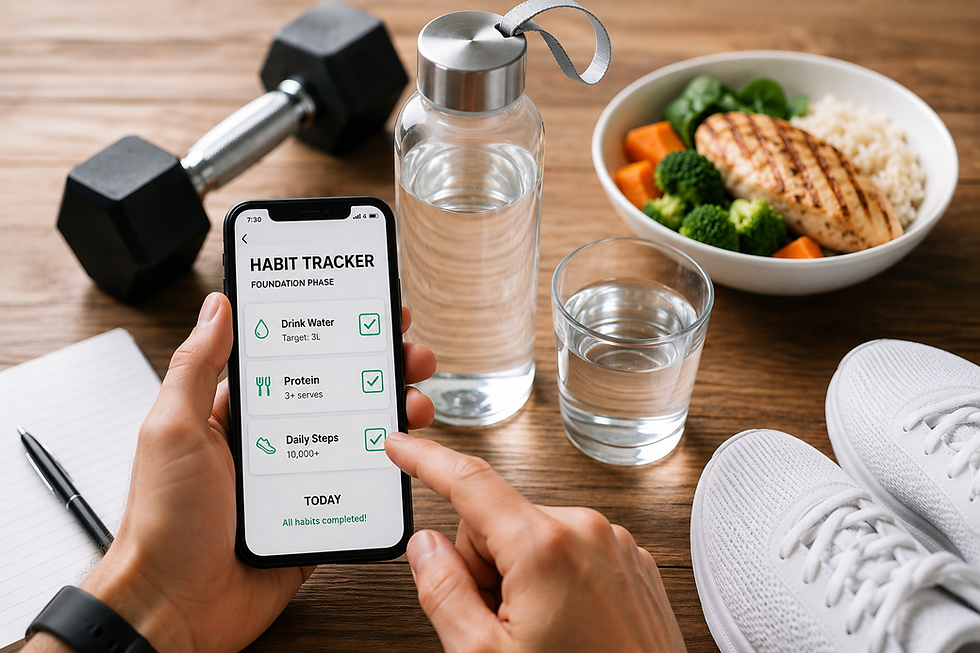
Foundation Phase focuses on habits that provide a large return for a relatively small amount of effort.
That's why we focus on:
Protein
Water
Daily movement
These habits influence almost everything else.
When daily movement improves, people often report:
More energy
Better recovery
Improved mood
Improved consistency
Better body composition outcomes
Not because walking is magic.
Because movement is normal.
And many people aren't getting enough of it.
What We See At The Training Ground
One of the most interesting patterns we see is that members who consistently hit their step targets often do better in other areas too.
They tend to:
Be more active overall.
Recover better.
Stay more engaged.
Build stronger routines.
I don't think that's an accident.
Walking often becomes a gateway habit.
When somebody starts consistently achieving their daily movement target, they usually become more aware of other health behaviours too.
Momentum matters.
Steps Are Often Easier Than More Training
This is another lesson many people don't expect.
When progress slows, the first instinct is often:
"I need to train more."
Sometimes that's true.
Often it isn't.
For many people, increasing daily movement is a far more sustainable solution than adding another hard training session.
A 20-minute walk.
A lunchtime walk.
Parking slightly further away.
Taking the stairs.
Small decisions repeated consistently add up.
And unlike many forms of exercise, walking is something most people can recover from very easily.
What About Fat Loss?
Let's address the obvious question.
Yes.
Daily steps can help support fat loss.
Not because walking is some secret fat-burning hack.
Because movement increases energy expenditure.
The more you move, the more energy your body uses.
But I'd argue that's actually the least interesting benefit.
Most people focus on the calorie-burning aspect and completely overlook the impact daily movement has on:
Health
Energy
Recovery
Consistency
Those benefits often matter just as much.
Do You Need 10,000 Steps?
Not necessarily.
The number itself isn't magical.
The goal isn't to hit a specific number because somebody on the internet said you should.
The goal is to move more than you currently do.
For one person that might mean:
6,000 steps per day
For another:
8,000 steps per day
For another:
10,000+ steps per day
That's why your coach may prescribe an individual target.
The target matters less than the habit.
The TTG Approach To Steps
At The Training Ground, we don't view steps as exercise.
We view them as movement.
There's a difference.
Exercise is planned.
Movement is something that should occur throughout your day.
The goal isn't to become obsessed with step counts.
The goal is to avoid becoming sedentary.
If a step tracker helps build awareness, great.
Use it.
If it helps create consistency, even better.
The Real Goal
The goal isn't to hit your step target for a week.
The goal is to become somebody who naturally moves more.
Somebody who:
Takes the stairs.
Goes for walks.
Moves throughout the day.
Doesn't spend every waking hour sitting.
That's the habit we're trying to build.
Because habits tend to last much longer than motivation.
The Long-Term View
One of the biggest mistakes in health and fitness is overlooking simple habits because they seem too easy.
Walking isn't flashy.
It won't generate dramatic social media content.
Nobody is posting about their lunchtime walk like they just completed an ultra-marathon.
But that doesn't mean it isn't important.
Some of the most powerful health habits are also the simplest.
Daily movement is one of them.
You don't need a complicated strategy.
You simply need to move more often than you do now.
And if you can do that consistently, the benefits tend to compound for years.


Comments