
The Truth About Autophagy: What The Research Actually Says
Part 3 of The Training Ground Guide to Fasting

If you've spent any time researching fasting,
you've almost certainly come across the word autophagy.
For some people, it's the primary reason they fast.
For others, it's proof that fasting is a longevity superpower.
And for many, it's a concept they've heard discussed repeatedly without ever really understanding what it means.
The challenge is that autophagy has become one of the most misunderstood topics in health and fitness.
Not because the science is bad.
But because the internet has taken a complex biological process and turned it into a simple marketing message.
You have probably seen claims such as:
"Autophagy starts at exactly 16 hours."
"You must fast for 24 hours to activate autophagy."
"Coffee increases autophagy."
"Autophagy prevents ageing."
"Autophagy only happens during fasting."
The problem?
Most of those statements are either incomplete, oversimplified, or not supported by strong human evidence.
Let's look at what the research actually tells us.
What Is Autophagy?
Autophagy literally means "self-eating."
Before you panic, that's a good thing.
Your body is constantly identifying, breaking down, and recycling damaged cellular components.
Think of it like a maintenance crew.
Every day, cells accumulate damaged proteins, worn-out components, and cellular debris.
Autophagy helps remove those materials so they can be recycled or disposed of.
Without autophagy, damaged cellular material would accumulate over time.
This is one reason researchers are interested in its potential role in:
Healthy ageing
Neurodegenerative disease
Metabolic health
Immune function
Cellular repair
Autophagy isn't a weird fasting hack.
It's a normal biological process that occurs throughout your life.
The First Myth: Autophagy Isn't Off Until You Fast
This is one of the biggest misconceptions.
Many people talk about autophagy as though it operates like a light switch.
You're eating.
Autophagy is off.
You stop eating.
Autophagy turns on.
Reality is much more complicated.
Autophagy is occurring continuously throughout the body.
The question isn't whether autophagy exists.
The question is whether certain conditions increase it.
Current evidence suggests they do.
These include:
Fasting
Exercise
Energy restriction
Certain cellular stressors
In other words, fasting doesn't create autophagy.
It appears to increase a process that already exists.
Why Has Autophagy Become So Closely Linked To Fasting?
Because fasting is one of the most practical ways researchers have observed increases in autophagy-related activity.
When nutrients become scarce, the body becomes more efficient at recycling existing resources.
From an evolutionary perspective, this makes sense.
If food isn't available, maintaining and recycling existing cellular components becomes increasingly important.
This is one reason fasting researchers have become interested in autophagy.
The challenge is that interest and certainty are not the same thing.
The Problem With Human Research
This is where things become difficult.
Measuring autophagy in humans is incredibly challenging.
Unlike body weight, blood glucose, or blood pressure, there isn't a simple home test.
Researchers often need tissue samples to directly measure autophagy-related processes.
For obvious reasons, that makes large-scale human studies difficult.
As a result, much of what people quote online comes from:
Animal studies
Cell culture studies
Mechanistic research
Theoretical models
Those studies are valuable.
They are not the same as definitive human evidence.
This distinction is important because many fasting claims are presented with a level of confidence that the research simply doesn't support.
So When Does Autophagy Start?
This is the question everyone wants answered.
Unfortunately, it's also the question we cannot answer with certainty.
You will often hear:
12 hours
16 hours
18 hours
24 hours
48 hours
The reality is that no universally accepted human timeline exists.
Different tissues may respond differently.
Different individuals may respond differently.
Different fasting durations may produce different effects.
Autophagy is not a timer that suddenly activates when your smartwatch tells you that you've reached hour sixteen.
It does not appear to operate as a universal on-off switch, and its response is likely to vary between tissues, individuals and fasting conditions.
That's less exciting than many internet headlines, but it's far closer to what the evidence currently suggests.
What About Coffee?
If you read our previous article, Does Coffee Break A Fast?, you'll know this is another area filled with confusion.
One of the most frequently cited studies found that both caffeinated and decaffeinated coffee increased markers associated with autophagy in mice.
The important detail?
Mice.
Not humans.
This finding is interesting.
It is not proof that coffee produces superior fasting outcomes in humans.
Nor is it proof that coffee creates a deeper state of autophagy than water-only fasting.
What it tells us is that coffee appears worthy of further research.
That is very different from saying the debate has been settled.
Does More Autophagy Mean Better Health?
This is another area where nuance matters.
Autophagy is generally viewed as beneficial.
However, biology rarely operates on a simple "more is always better" model.
Muscle growth is beneficial.
Too much growth can become problematic.
Inflammation is necessary.
Too much inflammation becomes problematic.
Autophagy appears important for health.
That does not automatically mean maximising autophagy should become the primary goal of your life.
Health is the result of many interacting systems.
Not one pathway.
What The Fitness Industry Gets Wrong
The fitness industry loves certainty.
Certainty sells.
"Maybe" doesn't.
"Possibly" doesn't.
"It depends" doesn't.
Unfortunately, science often lives in those uncomfortable middle grounds.
What we frequently see online is:
Research finding:
Fasting may influence autophagy.
Headline:
Fasting cleanses your body and prevents ageing.
Research finding:
Coffee increased autophagy markers in mice.
Headline:
Coffee supercharges fasting.
The further information travels from the original research, the more exaggerated it often becomes.
This is why we encourage members to be cautious when someone claims to have discovered the one protocol that unlocks perfect health.
What We Tell Members At The Training Ground
Autophagy is real.
It is important.
It is also only one piece of a much larger picture.
Many people become fascinated by cellular recycling while neglecting the behaviours that have far stronger evidence behind them.
Things such as:
Resistance training
Regular physical activity
Adequate protein intake
Quality sleep
Stress management
Maintaining a healthy body composition
These behaviours consistently demonstrate powerful health benefits across thousands of studies.
Autophagy may contribute to those outcomes.
But it should not distract us from the fundamentals.
The Bigger Question
A surprising number of people become interested in fasting because they believe it offers something calorie restriction cannot.
That raises an important question.
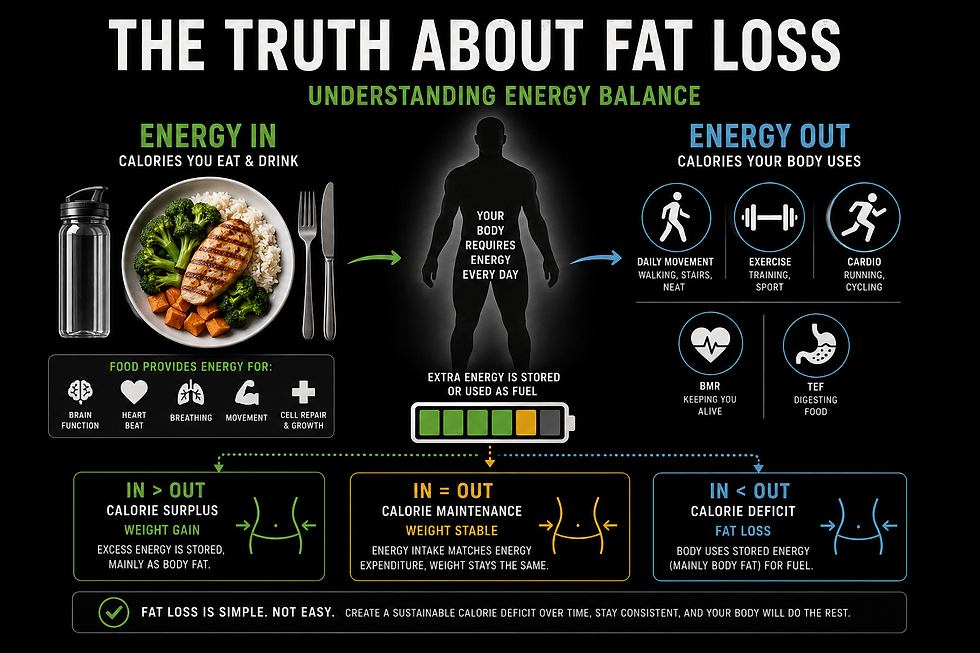
If fat loss ultimately comes down to energy balance, is fasting actually superior to traditional calorie restriction?
Or is it simply another tool that helps some people create a calorie deficit?
That's exactly what we'll explore next.
The Bottom Line
Autophagy is one of the most fascinating areas of modern health research.
What we know:
Autophagy is a normal biological process.
It helps recycle damaged cellular components.
Fasting appears to increase autophagy-related activity, although much of the strongest evidence comes from animal and mechanistic research, and human responses may differ between tissues.
Exercise appears to influence autophagy.
Autophagy likely plays an important role in health and ageing.
What we don't know:
The exact fasting duration required to maximise autophagy in humans.
Whether more autophagy is always better.
Whether specific fasting protocols produce dramatically superior outcomes.
The long-term impact of attempting to optimise autophagy in otherwise healthy people.
In other words, autophagy deserves interest.
It does not deserve blind certainty.
And perhaps that's the most important lesson.
The science is exciting.
The marketing is often ahead of the science.
References
Levine B, Kroemer G. (2008). Autophagy in the pathogenesis of disease. Cell, 132(1), 27–42.
Klionsky DJ, Abdel-Aziz AK, Abdelfatah S, et al. (2021). Guidelines for the use and interpretation of assays for monitoring autophagy. Autophagy, 17(1), 1–382.
Bagherniya M, Butler AE, Barreto GE, Sahebkar A. (2018). The effect of fasting or calorie restriction on autophagy induction: A review of the literature. Ageing Research Reviews, 47, 183–197.
Dethlefsen MM, Bertholdt L, Gudiksen A, et al. (2018). Training state and skeletal muscle autophagy in response to 36 hours of fasting. Journal of Applied Physiology, 125(5), 1609–1619.
Møller AB, Vendelbo MH, Christensen B, et al. (2015). Physical exercise increases autophagic signalling through ULK1 in human skeletal muscle. Journal of Applied Physiology, 118(8), 971–979.
Pietrocola F, Malik SA, Mariño G, et al. (2014). Coffee induces autophagy in vivo. Cell Cycle, 13(12), 1987–1994.
Aman Y, Schmauck-Medina T, Hansen M, et al. (2021). Autophagy in healthy ageing and disease. Nature Aging, 1, 634–650.


Comments