
The Truth About Fat Loss: Understanding Energy Balance

Everyone Wants to Burn Fat. Almost Nobody Understands How It Actually Happens.
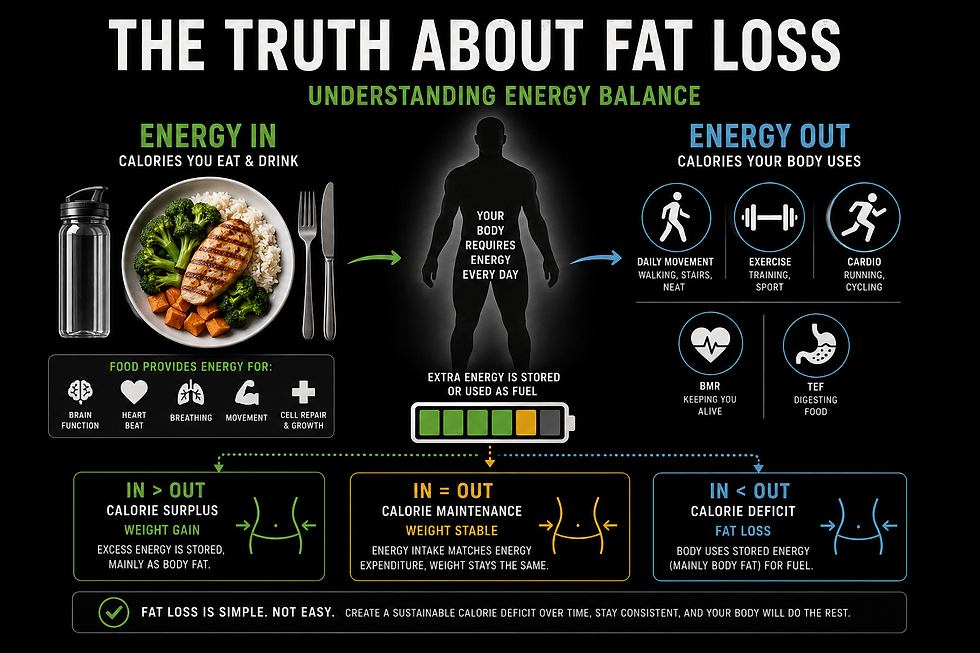
Walk into any supplement store, scroll through social media or listen to fitness influencers for five minutes, and you'll hear the same promises.
"This food burns fat."
"This workout melts fat."
"This supplement speeds up your metabolism."
The reality?
Your body doesn't lose fat because you eat a particular food or complete a certain workout.
It loses fat because, over time, it has no choice.
Understanding why is one of the most valuable things you can learn if your goal is sustainable weight loss.
Your Body Runs on Energy
Every second of every day, your body requires energy.
Even while you're asleep, you're using calories to:
Keep your heart beating
Power your brain
Maintain body temperature
Repair tissues
Produce hormones
Digest food
Keep every cell alive
Think of calories as your body's fuel.
Just like a car needs petrol, your body needs energy.
That energy comes from food.
What Is Energy Balance?
Energy balance simply compares:
Energy In: Calories you eat and drink.
versus
Energy Out: Calories your body uses throughout the day.
That's it.
Everything about weight gain, weight maintenance and weight loss begins here.
There Are Only Three Possible Outcomes
1. Energy In = Energy Out
You consume roughly the same amount of energy that you burn.
Result:
Your body has no reason to gain or lose stored energy.
Your weight remains relatively stable.
2. Energy In > Energy Out
You eat more energy than your body requires.
That excess energy has to go somewhere.
Some contributes to muscle growth if you're resistance training.
Some replenishes glycogen stores.
Once those needs are met, the remaining surplus is stored.
Mostly as body fat.
This is known as a calorie surplus.
3. Energy In < Energy Out
You burn more energy than you consume.
Now your body has a problem.
It still needs fuel.
So where does it get it?
It starts withdrawing energy from stored reserves.
This includes:
Body fat
Glycogen
In some circumstances, muscle tissue
This is known as a calorie deficit.
This is the only physiological environment where body fat can be reduced.
Your Body Isn't Burning Fat Because You Went For a Run
This is one of the biggest misconceptions in fitness.
People often believe:
"I burnt 600 calories today, so I lost fat."
Not necessarily.
Exercise increases your energy expenditure.
But fat loss only occurs if your total daily energy expenditure exceeds your total energy intake over time.
Imagine this:
You burn 500 calories during a workout.
Then celebrate with a muffin and a large smoothie worth 850 calories.
You've actually increased your energy intake by more than you burned.
The workout was still beneficial.
Your cardiovascular fitness improved.
Your muscles adapted.
Your mental health benefited.
But you haven't necessarily created a calorie deficit.
Where Does Your Energy Expenditure Actually Come From?
Many people assume exercise burns most of their daily calories.
It doesn't.
Your daily energy expenditure is made up of four main components.
1. Basal Metabolic Rate (BMR)
This is the energy required simply to stay alive.
For most people, it represents 60–70% of total daily energy expenditure.
This includes:
Breathing
Heart function
Brain activity
Cellular repair
Organ function
Even if you stayed in bed all day, you'd still burn a significant number of calories.
2. Physical Activity
This includes:
Gym training
Walking
Running
Sport
Gardening
Housework
Playing with the kids
Exercise is only one part of this category.
3. NEAT (Non-Exercise Activity Thermogenesis)
This is often the most overlooked factor in fat loss.
NEAT includes everything that isn't structured exercise:
Walking to your car
Standing at work
Cleaning the house
Taking the stairs
Fidgeting
Shopping
Moving around the office
For some people, NEAT differs by hundreds of calories every day.
Sometimes increasing daily movement has a greater impact than adding another gym session.
4. Thermic Effect of Food (TEF)
Digesting food also requires energy.
Protein has the highest thermic effect.
Your body actually uses more calories digesting protein than it does digesting fats or carbohydrates.
This is one reason high-protein diets are often more satisfying and supportive during fat loss.
Why "Fast Metabolisms" Aren't Usually What People Think
You've probably heard someone say:
"I can eat anything and never gain weight."
While metabolism varies between individuals, the differences are usually much smaller than people imagine.
More often, these people simply:
Move more without realising
Have higher muscle mass
Eat less across the week than they think
Naturally regulate their appetite
Have higher daily activity levels
Likewise, many people who believe they "hardly eat anything" often underestimate how much energy they're actually consuming.
Research consistently shows that both calorie intake and expenditure are commonly misreported.
This isn't dishonesty.
It's simply difficult for humans to estimate accurately.
Why Every Diet Works... Until It Doesn't
Low-carb.
Low-fat.
Keto.
Mediterranean.
Intermittent fasting.
High-protein.
Meal replacements.
Almost every successful diet has one thing in common.
They help people eat fewer calories than they burn.
The diet itself isn't magic.
The calorie deficit is doing the work.
Different approaches simply make that deficit easier for different people to maintain.
That's why the best diet isn't the trendiest one.
It's the one you can realistically follow for months, not days.
Why Weight Loss Isn't Always Fat Loss
The scales don't only measure body fat.
They measure:
Muscle
Water
Glycogen
Food in your digestive system
Bone
Body fat
This explains why your weight might fluctuate by 1-3 kg over a few days.
That doesn't mean you've gained or lost kilograms of fat overnight.
Most of those short-term changes are simply water and glycogen.
This is why at The Training Ground we don't rely solely on body weight.
We also assess:
Body composition
Waist measurements
Progress photos
Strength improvements
Performance
Consistency
These give a much clearer picture of what's actually changing.
Further Reading: Why BMI Doesn't Tell The Whole Story
So What's the Best Strategy for Fat Loss?
Forget searching for shortcuts.
Instead, build habits that naturally create a sustainable calorie deficit.
Focus on:
Eating enough protein to maintain muscle
Prioritising whole, minimally processed foods
Strength training two to four times per week
Increasing your daily steps and general movement
Sleeping seven to nine hours each night
Managing stress
Being consistent for months, not weeks
None of these are exciting.
But together, they're incredibly effective.
The Bottom Line
Fat loss isn't mysterious.
It isn't determined by one food, one supplement or one workout.
Your body stores energy when more comes in than goes out.
It uses stored energy when more goes out than comes in.
Everything else: meal timing, fasting, macronutrients, exercise selection and supplements.
All influence how easy or difficult it is to achieve that balance.
But they don't replace it.
Understand energy balance first, and every other nutrition strategy starts to make far more sense.
References
Hall KD, Guo J. Obesity Energetics: Body Weight Regulation and the Effects of Diet Composition. Gastroenterology. 2017;152(7):1718-1727.
Hall KD, Heymsfield SB, Kemnitz JW, et al. Energy Balance and Its Components: Implications for Body Weight Regulation. American Journal of Clinical Nutrition. 2012;95(4):989-994.
Levine JA. Non-Exercise Activity Thermogenesis (NEAT): Environment and Biology. American Journal of Physiology-Endocrinology and Metabolism. 2004;286:E675-E685.
Levine JA. Measurement of Energy Expenditure. Public Health Nutrition. 2005;8(7A):1123-1132.
Westerterp KR. Diet Induced Thermogenesis. Nutrition & Metabolism. 2004;1:5.
Rosenbaum M, Leibel RL. Adaptive Thermogenesis in Humans. International Journal of Obesity. 2010;34:S47-S55.
Thomas DM, Martin CK, Lettieri S, et al. Can a Weight Loss of One Pound a Week Be Achieved with a 3,500-kcal Deficit? International Journal of Obesity. 2013;37:1611-1613.
Dhurandhar NV, Schoeller D, Brown AW, et al. Energy Balance Measurement: When Something Is Not Better than Nothing. International Journal of Obesity. 2015;39:1109-1113.



Comments